Email is still the highest-ROI channel in the stack, and AI personalization just raised the ceiling again. Campaigns using AI-driven send-time, subject-line, and content personalization delivered a 41 percent average revenue lift versus non-personalised equivalents in 2025, according to Litmus's 2026 State of Email report.
But here's the catch: that 41 percent figure is the average across teams that implemented AI personalization properly. Teams that flipped on AI features without rethinking their data model, content strategy, or measurement framework saw lifts closer to 5 percent, sometimes zero, sometimes negative. The gap between the top performers and the bottom of that distribution is almost entirely about setup.
This guide is the platform-by-platform playbook for getting AI email personalization right in Klaviyo and HubSpot, the two tools we deploy most often with clients. We cover what AI email personalization actually does, how to decide between platforms, the five highest-ROI campaigns to launch first, a 30-day implementation roadmap, and the traps that flatten ROI if you miss them.
The 41 percent revenue lift: what the data actually shows
The Litmus 2026 report surveyed 1,800+ marketing teams and segmented results by AI maturity. The headline 41 percent lift breaks down like this:
- Teams with full AI implementation (predictive CLV, churn prediction, send-time optimisation, AI subject lines, dynamic content): +41 percent revenue per recipient
- Teams with partial AI (typically just send-time optimisation and subject-line AI): +14 percent revenue per recipient
- Teams running rule-based personalisation without AI: baseline
- Teams with AI enabled but no holdout testing or optimisation rhythm: +3 to 5 percent revenue per recipient
The difference between +41 and +5 is not the technology. It's the discipline around using the technology. Which brings us to the next question.
How AI email personalization actually works
There are four mechanisms that drive most of the lift. Understanding them helps you know what to demand from your platform:
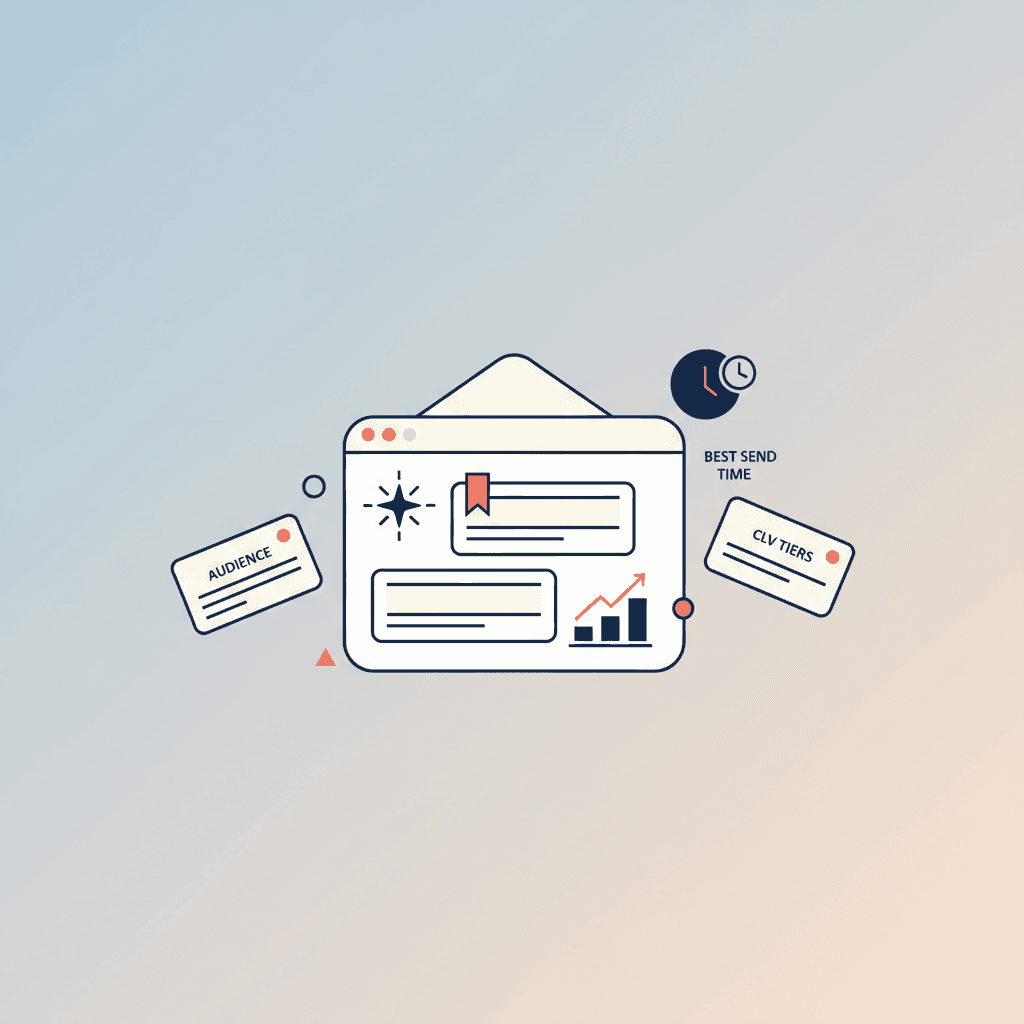
Predictive Customer Lifetime Value (CLV). The model assigns every contact a predicted lifetime spend based on past purchase behaviour, engagement patterns, and similarity to high-value cohorts. You can then segment aggressive campaigns (early-access, premium-tier emails) to the top 20 percent of CLV and protect margin on the bottom tier.
Churn / engagement risk scoring. The inverse of CLV: the model predicts which subscribers are about to disengage. This lets you fire re-engagement flows 7 to 14 days before a subscriber would have naturally gone dormant, when the win-back probability is still meaningful.
Send-time optimisation (STO). Instead of sending to your entire list at 10 AM, the algorithm picks the individual send time each subscriber is most likely to engage. Klaviyo's own benchmark data shows 15 to 22 percent open rate lift from STO alone on mature lists.
Dynamic content and product recommendations. The email body changes per recipient: product blocks show their likely next purchase, subject lines variant-test per segment, hero images rotate based on gender or location. This is where the largest share of the 41 percent lift comes from for ecommerce. For B2B, it's subject line personalisation and AI-generated copy blocks.
Note what's not in the list: AI writing your entire emails from scratch. That's a 2024-era pitch. The winning pattern in 2026 is AI optimising inside a human-designed flow, not replacing the flow designer.
Klaviyo vs. HubSpot for AI personalization
Both platforms shipped major AI updates in 2025 and 2026. They overlap more than they used to, but they're still fundamentally different products serving different core use cases.
| Capability | Klaviyo (2026) | HubSpot (2026) |
|---|---|---|
| Best fit | Ecommerce, DTC, Shopify/WooCommerce | B2B, services, complex sales cycles with CRM |
| Predictive CLV | Yes, well-tuned | Yes, at Marketing Pro+ tier |
| Churn risk scoring | Yes (Predicted Churn Probability) | Yes (via AI-powered lists) |
| Send-time optimisation | Smart Send Time, mature | Optimized Send Time, newer but improving |
| AI subject-line generation | Built in, good | Content AI, strong |
| AI copy generation (body) | Limited | Content AI, better |
| AI product recommendations | Catalog-aware, mature | Weaker (not their core) |
| SMS + email orchestration | Native | Requires Marketing Hub |
| Deep CRM / pipeline integration | Integrations only | Native, deep |
| Pricing (mid-market) | Scales with list size | Flat tiers |
| Time to first value | 2 to 3 weeks | 4 to 6 weeks |
Short version: if your business lives and dies by transactional email performance (ecom, subscription, DTC), Klaviyo is the right call in almost every case. If email is one channel inside a larger sales and CRM motion (B2B, services, considered purchases), HubSpot's native integration with the pipeline is worth more than Klaviyo's sharper email tooling.
The middle ground, and where we often end up, is Klaviyo for email plus HubSpot Starter for CRM. That stack typically costs 30 to 40 percent less than HubSpot Marketing Pro alone, and the two tools integrate well via native connectors.
5 high-ROI AI email campaigns to launch first
If you're starting from zero AI personalization, don't try to implement every feature. These are the five campaigns that produce the fastest measurable ROI in order of impact:
1. Predictive churn prevention flow
Target: contacts predicted to churn in the next 14 days. Trigger a 3-email re-engagement sequence with a specific-to-them incentive (not a generic discount). We see 8 to 18 percent of predicted churners re-engage, which sounds small but recovers meaningful LTV because these are subscribers you would have lost entirely.
Klaviyo setup: Create a segment "Predicted Churn Probability is High" (available in Flows). Trigger a 3-email flow: Day 0 "we noticed you've been quiet" + genuine product-value content; Day 3 "anything we can help with?"; Day 7 personalised offer.
HubSpot setup: Use AI-powered list "Likely to unsubscribe or go dormant". Trigger a workflow with the same email structure.
2. Predictive CLV tier segmentation
Segment the list into 3 to 5 CLV tiers and adjust cadence and offer aggressiveness per tier. Top tier gets early access, VIP content, and light promotional load. Bottom tier gets more aggressive acquisition offers and a win-back focus.
Most accounts see 20 to 30 percent revenue-per-email improvement just from segmentation alone, before any other AI features.
3. Send-time optimisation on all flows and campaigns
Flip STO on for every recurring email. This is the single highest-ROI change you can make in the first week. Expect 15 to 22 percent open rate lift, and roughly half that in click and revenue lift, within 2 to 3 cycles.
4. AI-generated subject line variants
Run AI-generated subject line A/B tests on every campaign. Campaign Monitor's 2026 data shows AI-suggested subject lines win against human-written ones roughly 55 to 60 percent of the time, and the AI-written winners outperform human winners by 12 to 18 percent on open rate. You're still writing the brand-voice ones, you're just adding 2 AI variants per campaign.
5. Dynamic product or content recommendations
Swap static product blocks or featured-content rails for AI-personalised recommendations. In Klaviyo, enable AI-driven product blocks in your core flows (post-purchase, browse abandonment, back-in-stock). In HubSpot, use smart content rules driven by lifecycle stage + predicted-interest topics.
Ecommerce accounts typically see 15 to 25 percent revenue-per-send lift on flows with dynamic product blocks within 30 days.
30-day implementation roadmap
Week by week, here's what we run with clients starting AI email personalization in 2026:
Week 1: data audit and baseline
- Audit list hygiene: cleanse inactive addresses older than 12 months, remove role-based addresses that never open
- Verify purchase data syncing correctly from your ecommerce or CRM platform to the ESP
- Establish baseline: average open rate, click rate, revenue per recipient, revenue per email for the last 90 days
- Set up a holdout group (10 to 15 percent of list) you will exclude from AI features to measure incrementality
Week 2: switch on fundamentals
- Enable send-time optimisation on all automated flows
- Enable AI subject-line variants on the next 4 campaigns
- Audit segmentation: create CLV-tier segments even before you use them, so the data accumulates
Week 3: high-impact flows
- Build the predictive churn prevention flow end to end
- Add AI-driven product (or content) recommendation blocks to 2 core flows: post-purchase and browse-abandonment for ecom, or lead-nurture for B2B
- Launch CLV-tier campaign experiments: run one VIP-tier and one bottom-tier campaign to see response differences
Week 4: measure and iterate
- Pull the holdout test: compare revenue per recipient in the holdout vs. the AI-personalised group. Expect 10 to 25 percent lift at this stage, full 40 percent comes later with more data
- Tune: pause or rewrite underperforming AI variants, double down on winners
- Set the ongoing rhythm: weekly subject-line A/B, monthly flow-level review, quarterly holdout re-measurement
After 30 days you have a baseline and a working system. The 41 percent number comes from consistent iteration over 90 to 180 days, not day one.
Mistakes that cancel AI's benefits
Flipping on AI features without a holdout group. Without a holdout you have no way to prove incrementality. When leadership asks for the ROI on the new email investment, "revenue went up 12 percent" is not enough, it could be seasonality. Always run a holdout.
Sending to every contact who ever opted in. AI models weight engagement heavily. If 40 percent of your list hasn't opened in 12 months, they're dragging your sender reputation down and your AI segmentation signals are noisy. Sunset or suppress unengaged contacts quarterly.
Treating AI subject lines as "write me copy". The best prompts are specific: "write 5 subject-line variants for a post-purchase email to customers who bought [product category], max 50 characters, warm but not over-eager." Generic "write me a subject line" prompts produce generic output.
Over-indexing on open rate. Apple Mail Privacy Protection has inflated opens since 2021 and the inflation got worse in 2026. Use click-through rate, conversion rate, and revenue per recipient as your primary metrics. Open rate is diagnostic only.
Skipping the CRM integration. The email performance ceiling is set by the quality of your audience data. If your ESP doesn't know which subscribers are active customers vs. prospects, it can't segment or optimise correctly. Integration with CRM and ecommerce is table stakes in 2026, not a nice-to-have.
Measuring success beyond open rates
The metrics we report to clients on AI email performance, in order of importance:
- Revenue per recipient (RPR), measured against holdout group. The primary ROI metric.
- Conversion rate on transactional goals (purchase, lead form submit, booking)
- Click-to-conversion rate, which isolates landing-page and offer quality
- List engagement health: 30-day and 90-day active-subscriber ratio
- Predictive model accuracy: how often the churn model's top decile actually churns (or doesn't, if the intervention worked)
Wire these up in GA4 with the email UTMs tagged consistently, reconcile to the ESP's reporting weekly, and use the new GA4 Conversion Attribution Report (released February 2026) to credit email touchpoints across the customer journey.
Frequently asked questions
How much data do I need before AI email personalization works? Klaviyo's predictive models calibrate after about 500 orders and 180 days of history. HubSpot's AI features work with roughly 1,000 contacts and 90 days of engagement data.
Is Klaviyo AI worth the upgrade from the free tier? For ecommerce stores above $50,000 annual revenue, yes. Below that, the free tier plus basic segmentation is usually sufficient.
Does HubSpot AI work without the CRM Pro tier? Partial functionality exists at lower tiers, but the full AI feature set needs Marketing Hub Professional or Enterprise.
How do I measure incrementality from AI personalization? Run a holdout test: exclude 10 to 15 percent from the personalised variant. Compare revenue per recipient after 30 to 60 days.
Is AI email content GDPR and POPIA compliant? Yes, as long as the underlying data processing is. AI-generated content doesn't change the compliance rules, lawful basis, unsubscribe, data minimisation, and transparency all still apply.
Will AI email personalization replace my email marketer? No. AI accelerates optimisation, but you still need a human marketer to set strategy, brand voice, and flow architecture.
The takeaway
AI email personalization in 2026 is real and the revenue lift is real, but only for teams that implement it as a system: data audit first, fundamentals before flows, holdout testing throughout, and iteration after launch. The 41 percent figure comes from discipline, not features.
If you want a second set of eyes on your current setup, or help implementing the 30-day roadmap above in Klaviyo or HubSpot, our email marketing team runs end-to-end audits and implementation engagements. For teams where email is tightly integrated with the CRM and sales pipeline, we combine email work with marketing automation so lead routing, scoring, and nurture all flow through one unified system.
Related reading: if you're also rethinking organic search alongside email, see our guide to Generative Engine Optimization in 2026, and if your paid-social spend is feeding your email list, the Meta Advantage+ 2026 playbook will help you close the loop between acquisition and retention.
Sources
- Litmus, 2026 State of Email Report
- Klaviyo, Email Benchmarks 2026
- Campaign Monitor, 2026 Email Benchmarks
- Google, GA4 Conversion Attribution Report
- HubSpot, AI in Email Marketing